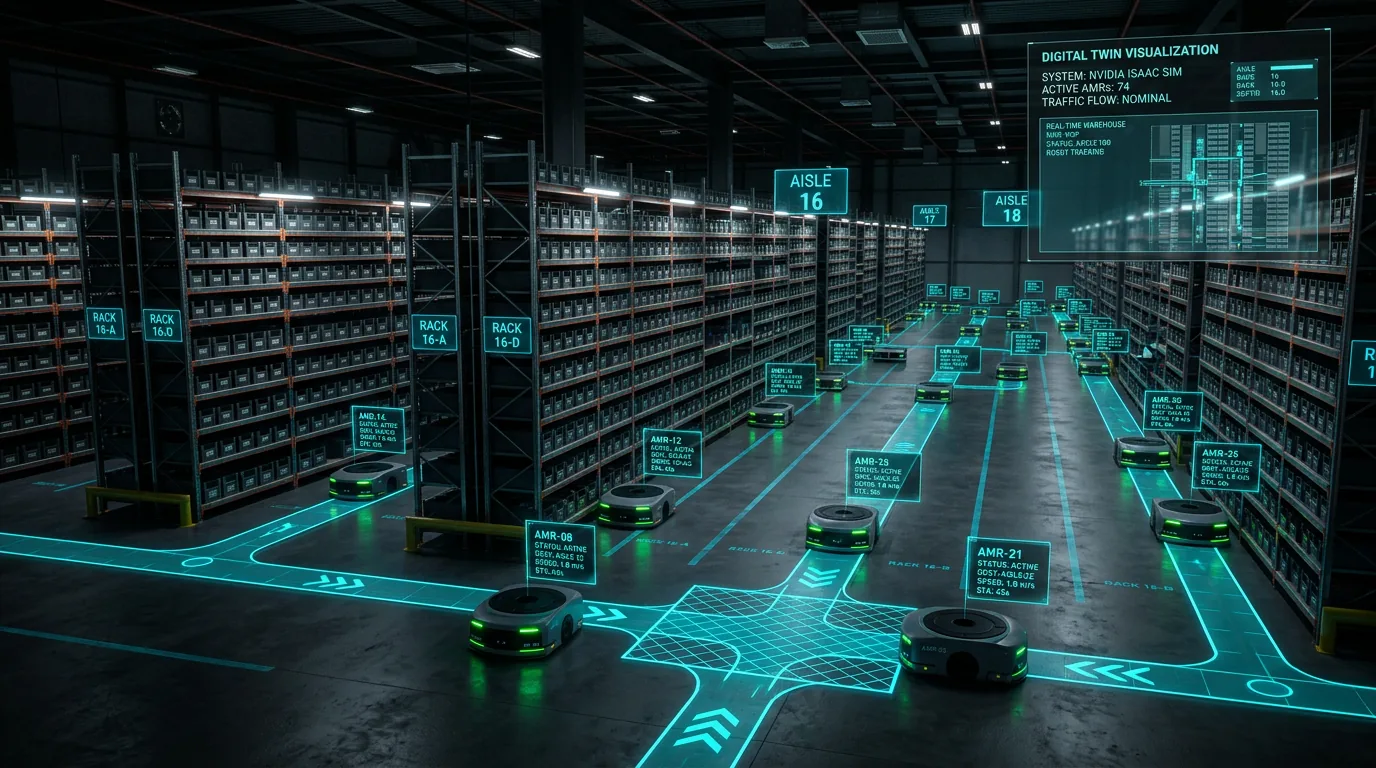
Representative program design — this case study illustrates the type of engagement Shailka-Robotics is built to deliver, not a completed project.
Situation
Consider a major third-party logistics (3PL) operator deploying autonomous mobile robots (AMRs) across a 450,000 sq ft distribution center. The initial deployment of 80 AMRs performs well at low density, but as the fleet scales toward 200+ units, congestion hotspots, charging queue conflicts, and pick-flow bottlenecks become unpredictable.
Key challenges:
- Congestion at scale: Path planning algorithms that work for 80 AMRs break down at 200+. Narrow aisle intersections become deadlock zones during peak order waves, causing cascading delays across the facility
- Charging infrastructure sizing: The operator provisions 24 charging stations based on vendor estimates, but real usage patterns show that charging queue wait times during shift changes exceed 18 minutes per robot -- consuming productive capacity
- No pre-deployment testing: New layout proposals (aisle widths, rack heights, pick zone assignments) are evaluated using static spreadsheet models. There is no way to observe emergent fleet behavior before committing to physical changes
- Picking strategy uncertainty: The operations team debates zone-based vs. wave-based vs. continuous picking strategies, but lacks a testbed to compare throughput and congestion impact across strategies
Technical Architecture
This program design specifies a warehouse digital twin with four simulation layers:
Facility Geometry (OpenUSD) The full warehouse layout -- racks, aisles, dock doors, staging areas, charging stations, and obstacle geometry -- is composed in OpenUSD. Rack configurations are authored as USD variant sets, enabling rapid comparison of alternative layout proposals without rebuilding the stage.
AMR Fleet Simulation (Isaac Sim) All 200+ AMRs are modeled as articulated agents with physics-based navigation, collision avoidance, and battery state. Each robot follows the same navigation stack and fleet management API used in the physical deployment, ensuring behavioral fidelity. Sensor noise and wheel slip models are calibrated against logged real-world telemetry.
Scenario Orchestration (Omniverse) Order wave generators, picking demand profiles, and shift-change events are scripted as simulation scenarios. The operations team can configure peak-hour load patterns, test holiday surge profiles, or inject equipment failures (broken charging stations, blocked aisles) to observe fleet response.
Telemetry and Analytics Pipeline Simulation runs emit the same telemetry format as the physical fleet management system. Throughput, congestion density, charging queue depth, and per-zone pick rates are aggregated in real-time dashboards, enabling direct comparison between simulated and historical production data.
Implementation Timeline
| Phase | Duration | Deliverable | |---|---|---| | Warehouse geometry import and USD composition | 2 weeks | Full facility digital twin | | AMR fleet modeling and calibration | 4 weeks | 200+ physics-based robot agents | | Scenario orchestration and demand modeling | 3 weeks | Peak-hour and surge scenario library | | Analytics pipeline and dashboard integration | 2 weeks | Real-time throughput comparison dashboards |
Projected Impact
- 30% throughput improvement projected through layout and routing optimizations tested in simulation
- Optimized charging station placement based on simulation-identified queue bottlenecks, targeting average charge wait reduction from 18 minutes to under 5
- Multiple layout proposals evaluated and scored in simulation before any physical rack movement
- Picking strategy validation through simulation comparison of zone-based, wave-based, and continuous approaches
- Pre-validated layout transitions minimizing risk of unplanned floor shutdowns
Expected Outcome
A warehouse operator following this program would establish a repeatable simulation sandbox for capacity planning, layout optimization, and fleet scaling decisions. The digital twin becomes the standard planning tool for network expansion -- each new facility deployment begins with a simulated layout evaluation. AMR congestion events are expected to decrease significantly after implementing simulation-recommended routing changes.