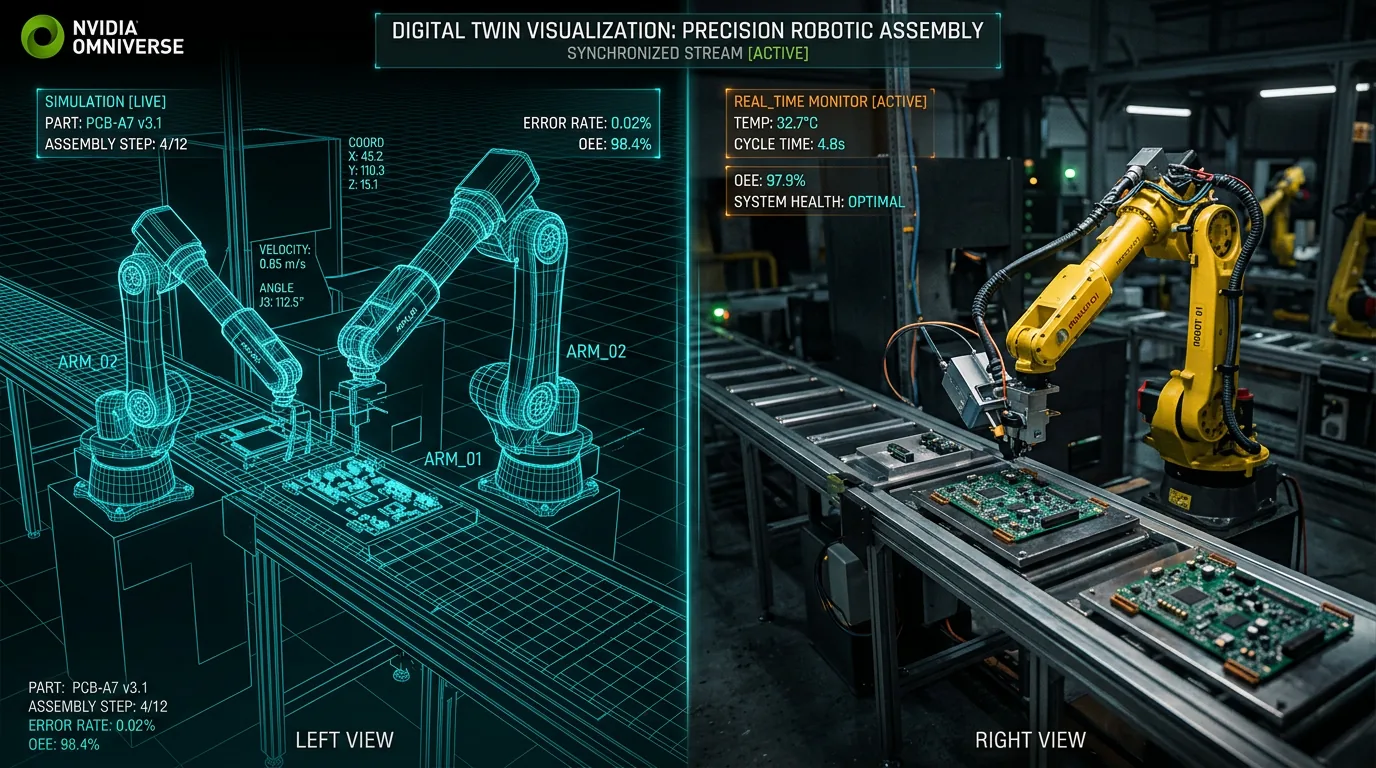
Representative program design — this case study illustrates the type of engagement Shailka-Robotics is built to deliver, not a completed project.
Situation
Consider a Tier-1 automotive parts manufacturer preparing to launch a new precision assembly line across two facilities. The line consists of 14 robotic workcells handling sub-millimeter tolerance components. Historical commissioning cycles consume 16--20 weeks of onsite tuning, with engineering changes frequently discovered during physical integration rather than during design.
Key challenges:
- Late-stage rework: Over 60% of layout changes were detected only after physical installation, driving up rework costs and delaying production start by an average of 8 weeks
- Cross-team misalignment: Mechanical engineers, robot integrators, and operations teams worked in isolated toolchains (CAD, offline programming, spreadsheet-based scheduling) with no shared visual reference
- Reachability validation gaps: Robot reach envelopes and collision avoidance paths were validated using 2D projections, missing critical spatial conflicts that only surfaced during physical dry-runs
- No rehearsal environment: Manipulation sequences for component insertion, fastening, and adhesive dispensing had never been tested virtually -- each was tuned manually on the factory floor
Technical Architecture
This program design specifies a four-layer digital twin:
Layer 1 -- Geometry Composition (OpenUSD) All CAD models (workcell frames, robot arms, end-effectors, conveyors, and fixturing) are imported into a unified OpenUSD stage. Composition arcs preserve the design hierarchy from each engineering team, enabling non-destructive overlay of changes. Component variants (gripper configurations, fixture versions) are authored as USD variant sets so the operations team can compare options without re-importing geometry.
Layer 2 -- Physics-Based Simulation (Isaac Sim) Each workcell is configured with Isaac Sim rigid-body and articulation physics. Robot controllers map to vendor-specific kinematic models (Fanuc and KUKA profiles). Manipulation sequences -- including insertion force profiles, adhesive bead paths, and torque-controlled fastening -- are scripted as Isaac Sim tasks and validated against tolerance envelopes.
Layer 3 -- Operator Review Environment (Omniverse) An interactive review application is deployed via Omniverse streaming so that operations managers, maintenance leads, and safety engineers can walk through the virtual line in real time. Annotations, measurement tools, and zone-based access control are configured per user role.
Layer 4 -- Continuous Synchronization (Nucleus) Nucleus provides real-time scene synchronization across design, simulation, and review sessions. Engineering changes pushed to Nucleus are immediately visible in all downstream environments, eliminating version drift between teams.
Implementation Timeline
| Phase | Duration | Deliverable | |---|---|---| | CAD ingestion and USD composition | 3 weeks | Unified stage with 14 workcells, 38 robot models | | Isaac Sim physics setup and controller mapping | 4 weeks | Validated manipulation sequences per workcell | | Operator review deployment and training | 2 weeks | Streaming application with role-based access | | Integration testing and sign-off | 2 weeks | Commissioning-ready digital twin |
Projected Impact
- 85% reduction in physical prototyping iterations targeted -- from an average of 12 layout revisions to 2
- 6 weeks saved in commissioning timeline projected compared to traditional line launches
- Spatial conflicts identified and resolved during virtual review that would otherwise require physical rework
- 100% reachability validation across all 14 workcells before any physical installation begins
Expected Outcome
A manufacturer following this program would move into physical commissioning with validated robot reachability, collision-free paths, and pre-tuned manipulation sequences. The digital twin becomes the single source of truth for cross-functional reviews, replacing disconnected CAD screenshots and spreadsheet-based coordination. The program model is designed to serve as the standard commissioning workflow for all new line deployments.